J Kiss LLC
A Dallas–Fort Worth hauling company that takes quotes, books jobs, dispatches crews, hires staff and runs payroll from one connected system rather than six disconnected ones.
Please note: A business I own and operate.

- My role
- Founder-operator and sole developer. I built the platform this business runs on and continue to ship to it.
- Built for
- Local service businesses
- Current status
- Live and in daily production use.
- Built with
- Next.js · TypeScript · Supabase · Stripe · Twilio · Resend · Vercel
The story
What problem existed, and what we built.
The problem
A growing service business collects work from everywhere — phone calls, texts, a form, word of mouth — and then has to turn that into a scheduled crew, a truck, an invoice and a paycheck. Every hand-off between those steps is a place where a job gets lost, double-booked, or done and never billed.
What I built
One platform that carries a job from first enquiry to final payment. A customer gets an instant estimate from a guided quote wizard; the job becomes a dispatchable booking; the crew is scheduled; the invoice and the payroll entry come out the other end without anybody re-typing anything.
What it had to achieve
- Turn an enquiry into a scheduled, priced job without a phone tag loop
- Give the office one screen for the day instead of a whiteboard and a group chat
- Make hiring a pipeline instead of a pile of texts
- Pay people from records the system already has
The customer's experience
Someone with a garage full of furniture answers a handful of plain questions and gets a price. They book a window. They get a confirmation, and then updates as the job moves — instead of waiting on a callback that may or may not come.
What customers can do
- A guided quote wizard that returns a real estimate, not 'we'll call you back'
- Online booking with confirmations
- Job tracking so the customer knows where things stand
- An apply-online careers portal for people who want to work there
The owner & staff experience
The morning starts on the dispatch board rather than in a text thread. Jobs, crews and trucks are all in one view. Applications land in a pipeline. On Friday, payroll draws on the statements the system has been keeping all along.
What the business can do
- Dispatch board — who is doing what, in which truck, today
- Crew scheduling and staff records
- Invoicing and payments
- Payroll with historical statements, contractor addresses and a Friday pay-period schedule
- An applicant tracking system for hiring
- A communication center so customer messages live with the job, not in a personal phone
How it works
The system, explained without the jargon.
If a technical term is needed below, it's explained right where it appears.
One job record, many stages
A quote, a booking, a dispatched job and an invoice are all the same underlying record moving through stages. Nothing is re-keyed, so nothing drifts out of sync.
Roles that match the org chart
Owner, office staff and crew see genuinely different systems. Permissions are enforced on the server, so the interface hiding a button is not the only thing protecting the data.
Guarded messaging
The system can text customers, but automated and scheduled texts are deliberately switched off at the platform level. Reminders still go out by email and in-app; a person has to choose to send a text. That is a policy decision, wired in as code rather than left to discipline.
Bookings that can't collide
The booking path is protected against a customer double-submitting and against two requests claiming the same capacity — the kind of bug that shows up as a mystery duplicate job weeks later.
Design decisions
The choices that shaped it — and why.
An instant estimate, honestly bounded
The quote wizard gives a real number where it safely can and routes to manual pricing where it can't, rather than guessing and then walking the customer back down.
Automated texting stays off
Full SMS is provisioned and working, but scheduled sends are suppressed on purpose. Text messages to customers are a trust surface, and 'the system decided to text them' is not a good enough reason.
How it was built
Development process
- 1Built the booking, invoicing and payments core first
- 2Added the careers portal and applicant tracking as hiring became the bottleneck
- 3Layered on the quote concierge wizard
- 4Hardened the booking pipeline with end-to-end tests after real-world edge cases appeared
- 5Added payroll statements, contractor addresses and the Friday pay schedule
- 6Currently building claims handling and crew deductions
Where it stands
Status & outcome
Current status
Live and in daily production use.
Outcome
The business runs on it every day. It is the reference implementation for the operations platform now offered to other companies — the multi-tenant version described in the Operion write-up.
Related projects
You might also want to see
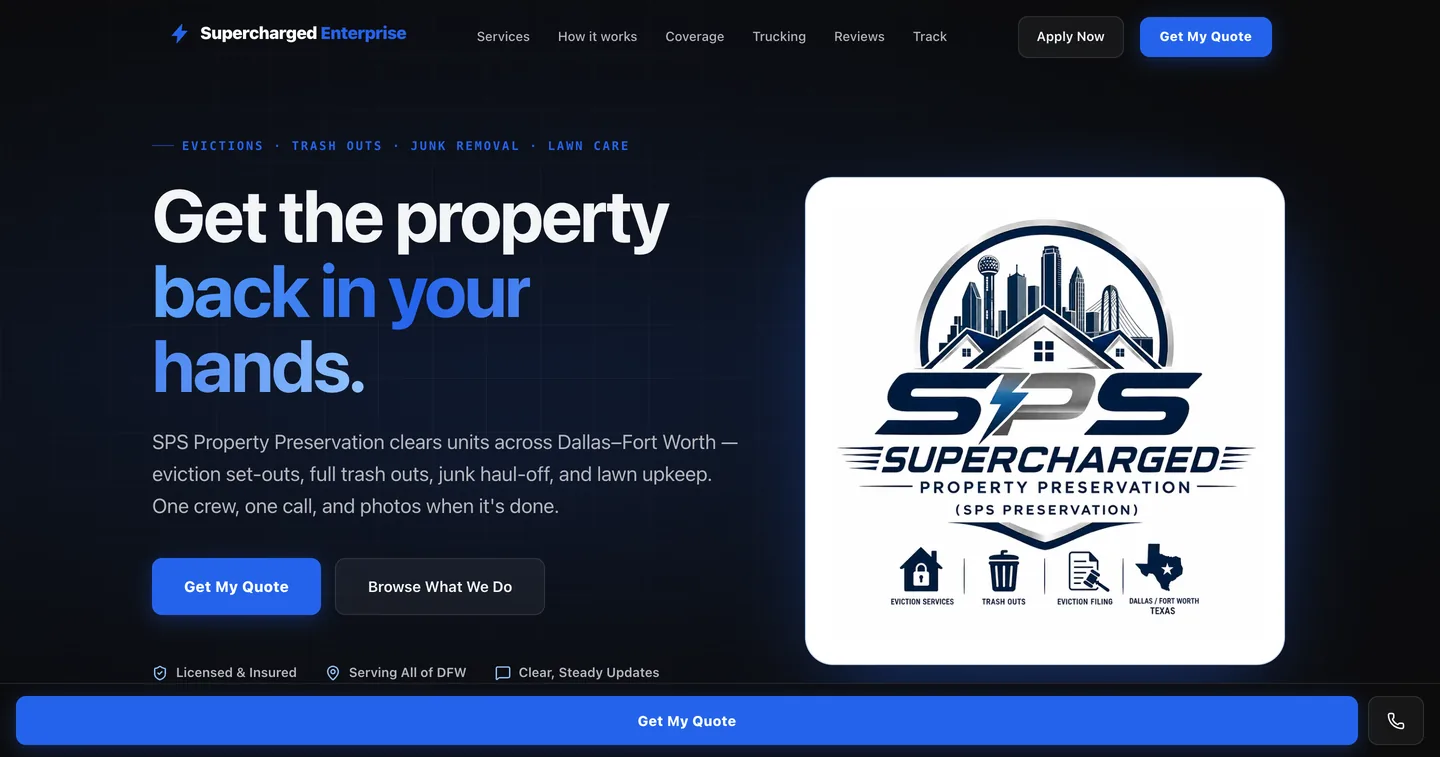
Supercharged Enterprise
Operations platform, second tenant · My own venture
A property-preservation company — evictions, trash outs, junk removal and lawn care — running on the same operations platform with its own brand and pricing.
Read the case study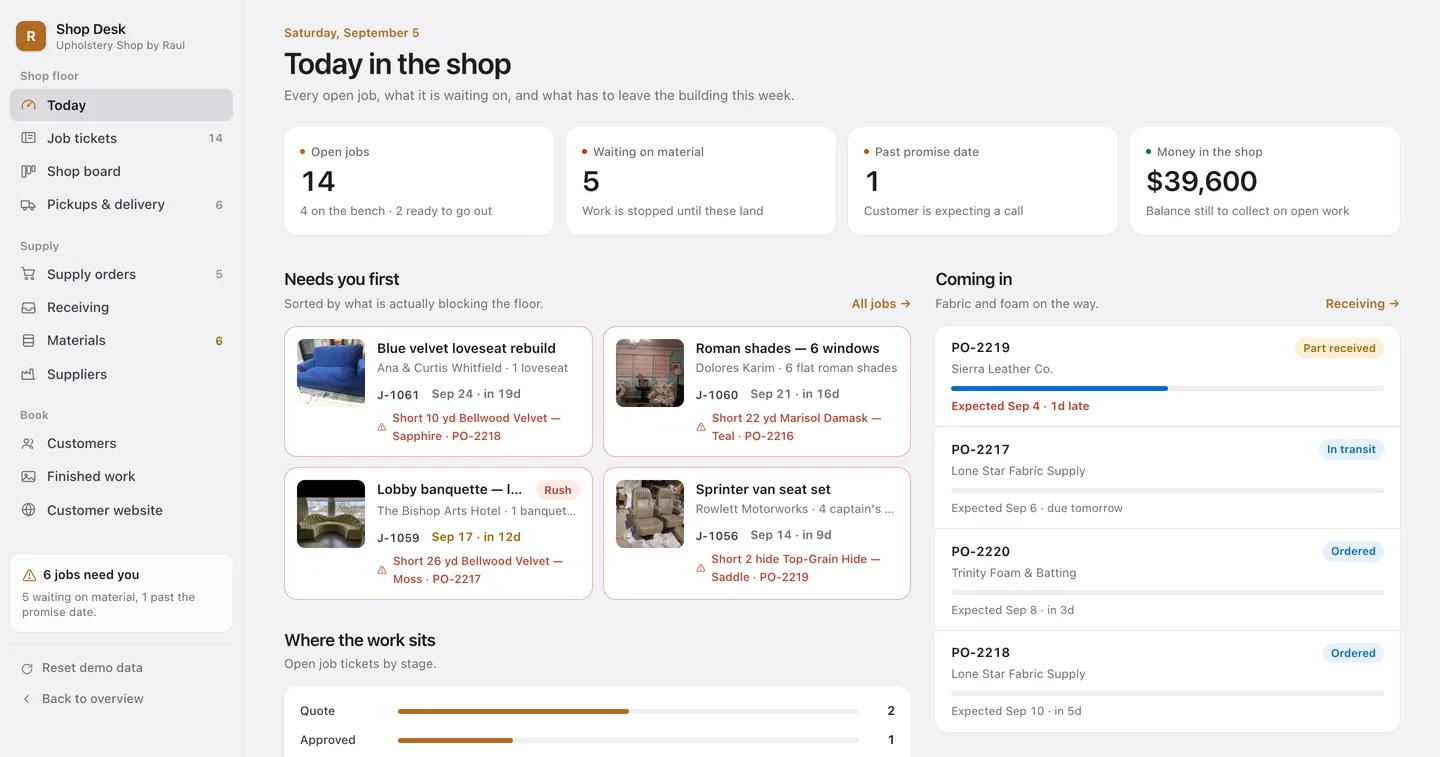
Shop Desk — Upholstery Shop by Raul
Shop management system · Demonstration build
A working preview of a shop system where purchasing and production are one thing: a job short on fabric says so on its own ticket, on the shop board, and on the dashboard.
Read the case studyWant something like this for your business?
Tell me how your days go and what you'd like to stop doing by hand. I'll tell you honestly what would help.