Supercharged Enterprise
A property-preservation company — evictions, trash outs, junk removal and lawn care — running on the same operations platform with its own brand and pricing.
Please note: A business I own and operate.
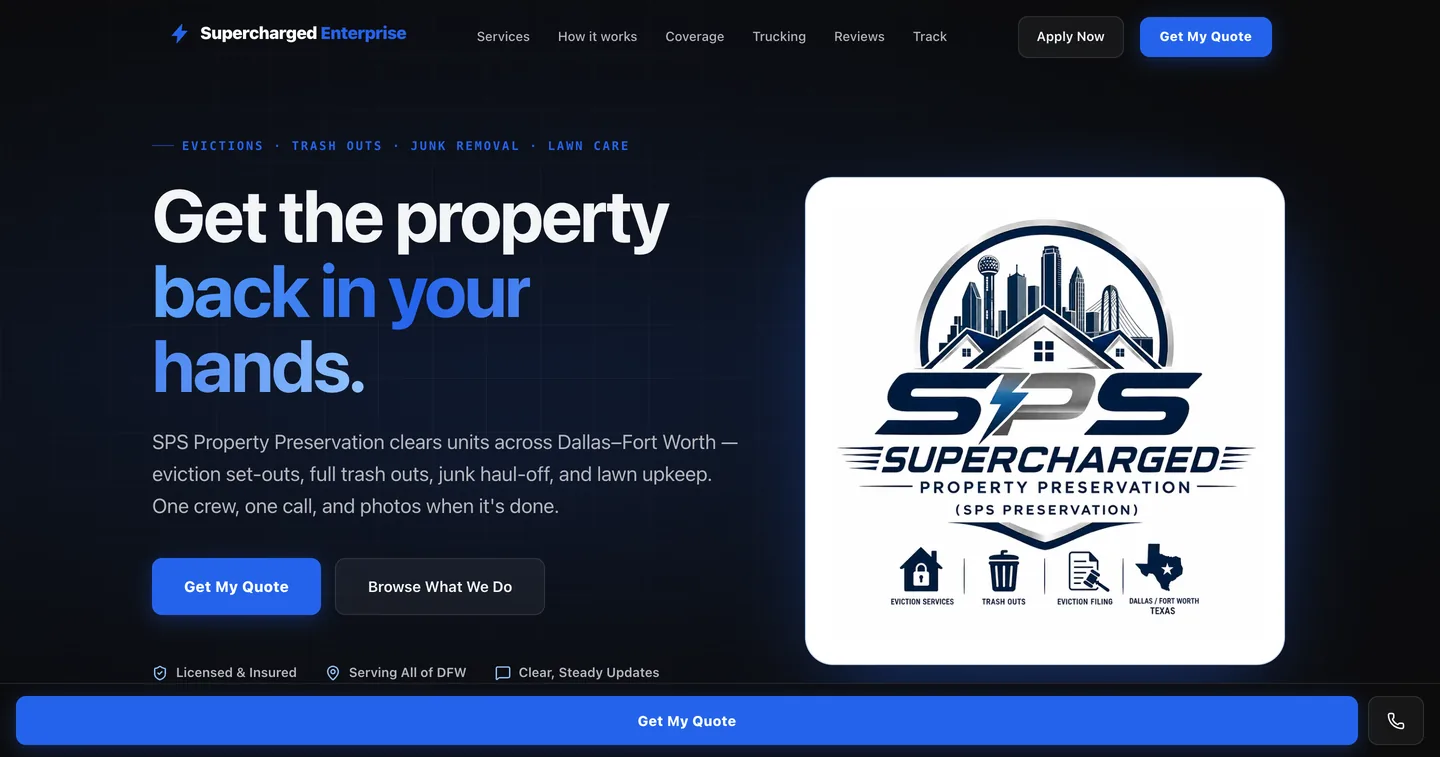
- My role
- Architect and developer.
- Built for
- Property services
- Current status
- Live on its own domain. Several integrations — payments, texting, email — are not yet configured for this tenant.
- Built with
- Next.js · TypeScript · Supabase · Vercel
The story
What problem existed, and what we built.
The problem
Proving the operations platform could carry a second business with different services, different pricing and a different brand, without forking the code.
What I built
A second tenant with its own identity and service catalogue, sharing the platform's booking, dispatch, payroll and reliability work.
What it had to achieve
- Run a second business on the shared platform
- Prove the booking path end to end in production
The customer's experience
A property manager requests a clear-out, gets a price, and books it.
What customers can do
- Quote wizard
- Online booking
- Job tracking
- Careers applications
The owner & staff experience
The same operations system as the sister company, with its own services and pricing.
What the business can do
- Dispatch and crew scheduling
- Operations dashboard
- Payroll
- Alerting
How it works
The system, explained without the jargon.
If a technical term is needed below, it's explained right where it appears.
Reliability that was proven, not assumed
Booking writes are serialized so two simultaneous requests cannot claim the same slot, and alert delivery was tested rather than trusted — an alerting system nobody has ever seen fire is not an alerting system.
Design decisions
The choices that shaped it — and why.
Diagnose with evidence, not theory
Two plausible explanations for low bookings were both disproven by driving the real booking path in production. The remaining issue is reaching customers, not the software — which is a different problem with a different fix.
How it was built
Development process
- 1Cloned and rebranded from the sister company
- 2Ran a reliability wave — booking idempotency, capacity admission, payroll locks
- 3Verified the booking flow end-to-end in production
- 4Proved alert delivery
Where it stands
Status & outcome
Current status
Live on its own domain. Several integrations — payments, texting, email — are not yet configured for this tenant.
Outcome
The platform demonstrably carries a second business. This tenant's integrations are still being configured.
Related projects
You might also want to see
Operion
Multi-tenant operations platform · My own venture
The platform behind J Kiss and Supercharged, generalized so more than one company can run on the same codebase without seeing each other's data.
Read the case study
J Kiss LLC
Operations platform for a service business · My own venture
A Dallas–Fort Worth hauling company that takes quotes, books jobs, dispatches crews, hires staff and runs payroll from one connected system rather than six disconnected ones.
Read the case studyWant something like this for your business?
Tell me how your days go and what you'd like to stop doing by hand. I'll tell you honestly what would help.