Operion
The platform behind J Kiss and Supercharged, generalized so more than one company can run on the same codebase without seeing each other's data.
Please note: A business I own and operate.
- My role
- Architect and developer.
- Built for
- Growing service companies
- Current status
- Two tenants run on it. Full multi-customer availability is still in progress.
- Built with
- Next.js · TypeScript · Supabase · Stripe · Twilio · Anthropic Claude
The story
What problem existed, and what we built.
The problem
Having built one company's operations system, the obvious question is whether a second company can run on it. The answer is only yes if each company's data is genuinely separate and each can be configured differently without forking the code.
What I built
A shared platform where each business is a tenant with its own data, branding, pricing and settings — currently running two companies in lockstep.
What it had to achieve
- Run more than one business on one codebase
- Keep tenants genuinely isolated, not just visually separated
- Make AI features cost-bounded and observable
The customer's experience
Identical to the individual companies — each tenant's customers see that company's own site.
What customers can do
- Everything the individual companies offer — quotes, booking, tracking, careers
The owner & staff experience
Each company gets the full operations system configured to its own services, pricing and branding.
What the business can do
- Dispatch, crew, payroll, claims and communications
- Role-based access across three permission tiers
- AI-assisted operations with cost caps and health checks
- Per-tenant branding, pricing and configuration
How it works
The system, explained without the jargon.
If a technical term is needed below, it's explained right where it appears.
Shared code, separate data
Both companies run the same application. What differs is configuration and data — which is what makes a third company a setup task rather than a rebuild.
Shared code is not shared state
A feature shipping in the codebase does not mean it is live for every tenant — each tenant is configured separately, and the platform is explicit about that distinction rather than assuming it.
Design decisions
The choices that shaped it — and why.
AI work has a spending ceiling
AI-assisted analysis runs under a daily cost cap with a health check that can genuinely report an outage, rather than failing quietly and expensively.
How it was built
Development process
- 1Generalised the J Kiss operations system into a tenantable platform
- 2Built role-based access across three tiers and the communication center
- 3Added an AI provider seam so the language-model provider can be swapped
- 4Currently working toward general multi-customer availability
Where it stands
Status & outcome
Current status
Two tenants run on it. Full multi-customer availability is still in progress.
Outcome
Two companies run on it today. It is not yet generally available to outside customers.
Related projects
You might also want to see

J Kiss LLC
Operations platform for a service business · My own venture
A Dallas–Fort Worth hauling company that takes quotes, books jobs, dispatches crews, hires staff and runs payroll from one connected system rather than six disconnected ones.
Read the case studySupercharged Enterprise
Operations platform, second tenant · My own venture
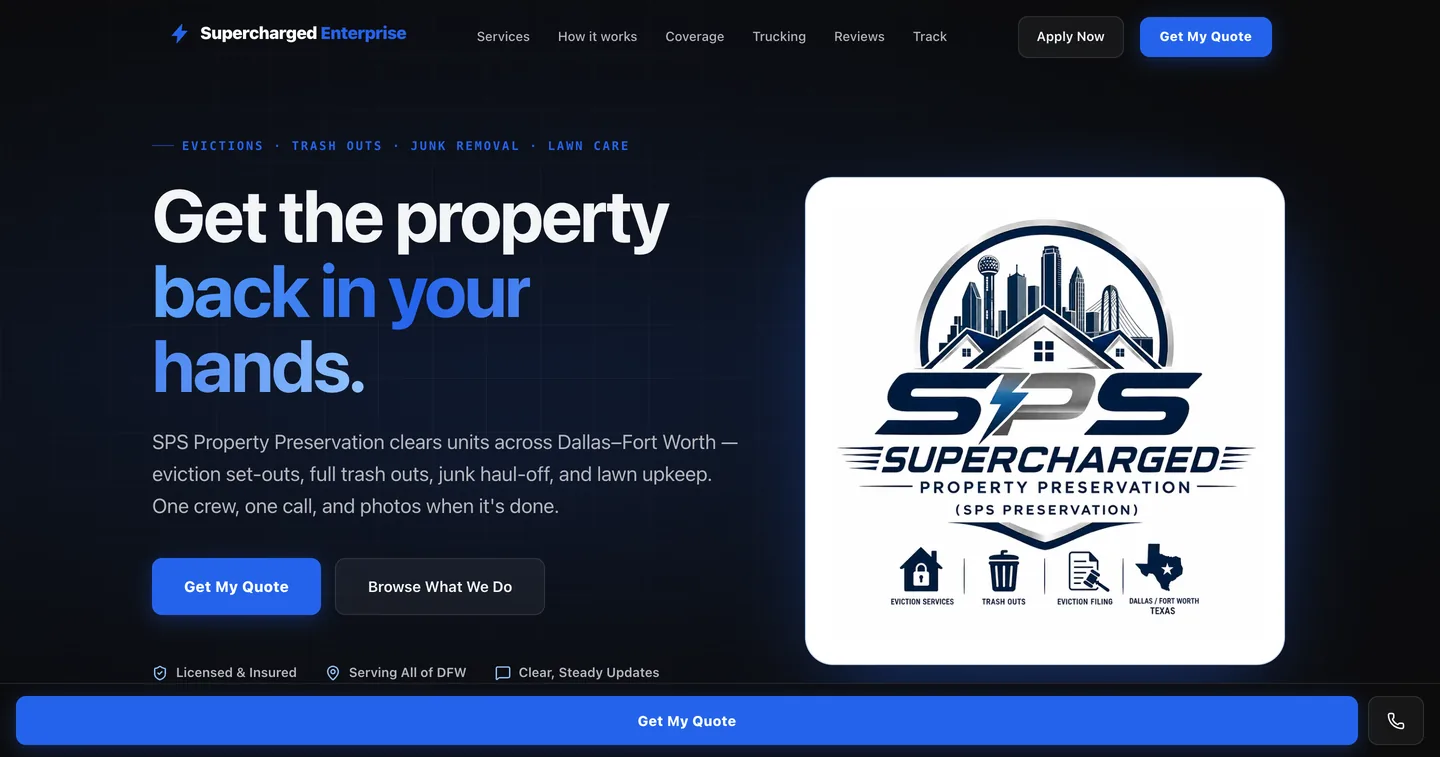
A property-preservation company — evictions, trash outs, junk removal and lawn care — running on the same operations platform with its own brand and pricing.
Read the case studyWant something like this for your business?
Tell me how your days go and what you'd like to stop doing by hand. I'll tell you honestly what would help.